Sustainability is not just a passing trend. It is a business case.
Review: tfz Product & System Cluster Insights – Developing efficiently and sustainably
This insight, which was summarised during the discussion following the presentations, ran like a common thread through the tfz Product & System Cluster Insights event held on 16 June 2026 at ABNOX AG in Cham: using fewer resources leads to more efficient production, and this benefits both companies and customers alike. The examples provided by the two speakers demonstrated this impressively. But before turning to solutions, the starting point was laid out: 62 billion kilograms of electronic waste were generated worldwide in 2022. Only 22.3 per cent of this was properly recycled. And the mountain of waste is growing five times faster than recycling capacities. What if the answer to this lies not in recycling, but right from the moment a product is conceived on the drawing board?
Sustainable electronics starts with asking the right question
David Schmid, Head of Regional Development at CSEM, made it clear right from the start: there is no single ‘green’ solution. The crucial question is not ‘Which material is more sustainable?’, but ‘How long should this product actually last?’ Because depending on its lifespan and use case, a completely different strategy is required. Short-lived products manufactured in large quantities, such as those in the IoT and sensor sectors, place particular demands on material selection, manufacturing and end-of-life management. In these cases, decisions made early in the development process have a disproportionately large impact later on.
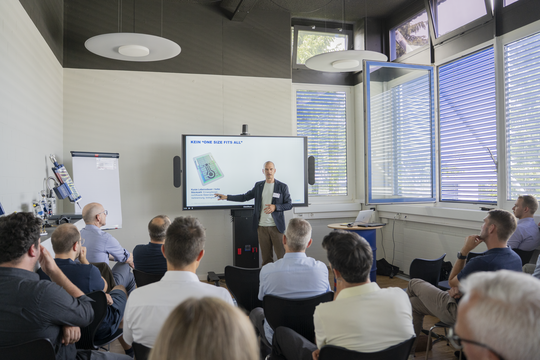
Architectural decisions can be more effective than choosing a ‘greener’ material. CSEM has already demonstrated this in specific research projects. To find out which approaches have proved particularly effective and how this can be applied to your product development, you’ll need to come and see for yourself.
From Strategy to Practice
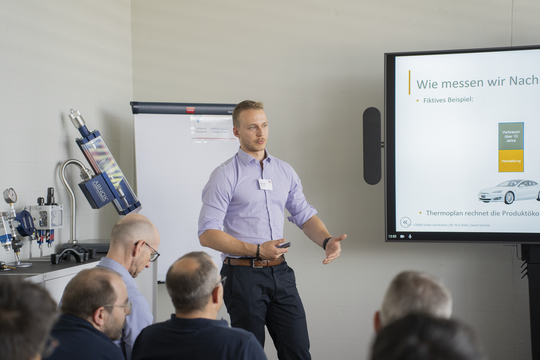
Björn Jung, Head of Sustainability at Thermoplan, demonstrated how a Swiss industrial company views sustainability not as a mere formality, but as a strategic competitive advantage. The key: sustainability must be embedded in product development, as around 80% of a product’s environmental impact is determined as early as the concept phase. Thermoplan has been relying on modularity as a core principle since 1998. Interchangeable modules facilitate repairs, extend product lifecycles and lay the foundation for circular business models that are both environmentally and economically beneficial.
Whilst the circular economy significantly reduces material costs, it simultaneously increases transport and labour costs. We are deliberately saving for the next round the discussion of whether and how this pays off, and what is needed to ensure that quality and circularity truly go hand in hand.
An in-depth exchange
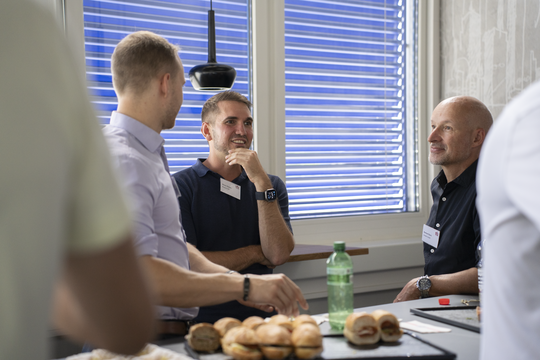
What made the event so special was the blend of research perspectives and real-world business practice. During the discussion that followed, the ideas were explored in depth, with questions that highlighted just how much the topic is already on the agenda within the participants’ companies.
A heartfelt thank you to ABNOX AG for hosting us and providing the ideal setting for this exchange.
Weren’t you there?
Then you now know what to expect the next time you’re there. Genuine, in-depth insights, people who think just like you, and content you won’t find anywhere else. We look forward to welcoming you to the next tfz event.