How the 2026 Zug Innovation Day Redefined the Limits of Predictability
When artificial intelligence manages harvests, components warn of their own impending failure, and language models astonish us with surprising emotional intelligence, a fundamental question arises: How much of our world will actually still hold surprises tomorrow? Under the telling motto “Predictive World – the Impact,” the Siemens Inspiration and Convention Center was transformed on September 15, 2026, into a hub for perspectives on technology, futurology, and philosophy. More than 200 executives, thought leaders, and tech pioneers from the region came together to explore the question of how we can shape a world that can be calculated with ever-greater precision.
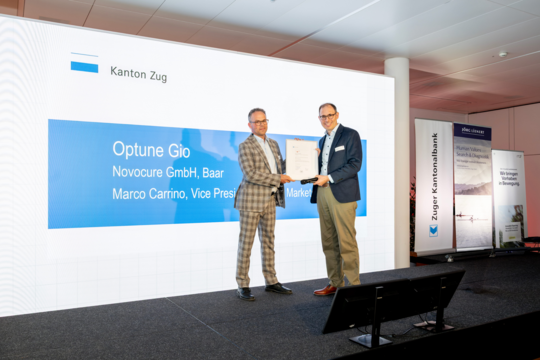
A Beacon for Medical Technology
The event kicked off with the presentation of the 2026 Zug Innovation Award. The award, which comes with a prize of CHF 10,000, is presented by the Zug Cantonal Government. This year, it went to Novocure GmbH in Baar. Andreas Conne, Secretary General of the Department of Economic Affairs and Secretary of the Innovation Award Jury, personally presented the award.
Between Megatrends and the Contemplative Silence in the Hall
Two outstanding figures then shed light—from completely different perspectives—on just how profoundly data and forecasts are already transforming our everyday lives. Georges T. Roos, one of Switzerland’s leading futurists, took the audience on a journey through the five major transformations of our time. He examined the demographic, ecological, geopolitical, biotechnological, and digital upheavals. His perspective on AI development, in particular, caused a murmur to ripple through the hall: Today’s language models already perform 44 percent better than the average person in emotional intelligence tests and, at times, even tell better jokes.
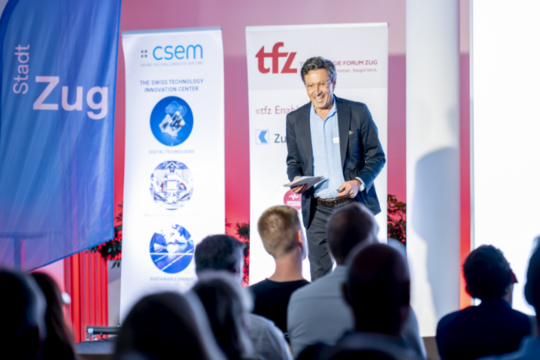
The prominent Swiss philosopher Yves Bossart provided a compelling counterpoint. Amid absolute silence in the hall, he questioned our deep urge to want to control every aspect of life. Citing the sociologist Hartmut Rosa, he reminded us that the real magic often lies in the unpredictable. There are no certainties, and that’s a good thing. True transformation does not arise from algorithms, but rather where resonance, emotional connection, and genuine human encounters take place.
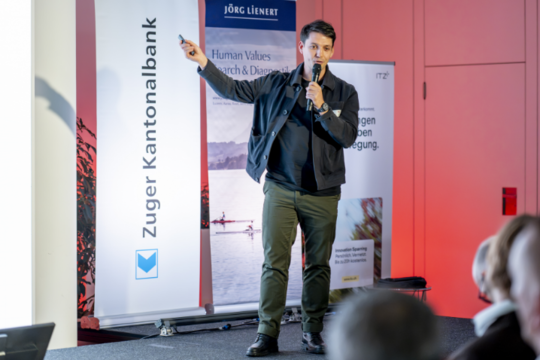
High Speed on Stage
The fast-paced InnoTag Sprints demonstrated that the business world has long been putting the principle of predictability to practical use. In three sessions, 15 companies pitched their projects on the main stage, each strictly limited to 90 seconds:
- Neosight AG
AI as an Intelligent Sparring Partner for Leadership Teams: In this sprint, we’ll showcase an innovative approach to integrating artificial intelligence as a management sparring partner to specifically improve decision-making quality, collaboration, and organizational performance - V-Zug
Predictive Quality Management in the Market: “See, Understand, & Act”—Using AI to see and understand what’s coming—before the customer notices it - Siemens
From Data Silos to the Connected Factory: The Key to Industrial AI at the Siemens Factory in Zug - CSEM
Wearables: The Key to Personalized Medicine: Medical wearables are central to prevention, diagnosis, and treatment. The next generation sets new standards in functionality, reliability, and comfort. High technology makes it possible. - Lightscale AI
From “Vibe” to “Verified” Coding: Lightscale AI makes software development predictable: Thanks to compiler verification and a new AI programming language, it guarantees safety and correctness for business-critical software. - Fraunhofer IPA
Predictive Process Optimization—how AI finds the optimal process parameters: Want the machine itself to predict process parameters autonomously? The combination of transfer learning and AI quickly finds the optimal settings with minimal data requirements. - botts.ai
Know what customers will ask tomorrow: Today, you find out about customer problems too late. botts.ai turns your website into an agent that predicts tomorrow’s conversations. - Siemens Healthineers
The future begins before the diagnosis: From risk assessment to CT scan in a single appointment: AI-powered lung cancer screening demonstrates how a predictive world transforms early insights into real-world benefits. - Datwyler
Robotics: From the sense of touch to precise grasping: Soft, tactile sensor solutions from Datwyler enable robots not only to detect touch, pressure, and object movements, but also to interpret them proactively—thereby handling objects safely and appropriately for the situation. The collection of human grasping data forms the foundation for teaching robots a natural, adaptive, and anticipatory understanding of movement: The next step is not merely executed but anticipated. - WWZ
How much electricity will Zug need tomorrow at 2 p.m.?: How AI and expert knowledge at WWZ make electricity forecasts more precise. - Precira in collaboration with ITZ
Predictive Agriculture: How AI and Lasers Are Rethinking Weed Control: Precira demonstrates how autonomous robotics remove weeds without chemicals—efficiently, precisely, and ready for use in real fields. - IQVIA
How AI identifies high-risk patients and triggers immediate action: Between risk identification and better care lies implementation. That’s exactly where technology can make a difference. - RUAG in collaboration with Digital & AI Community
Fault currents and hairline cracks: How RUAG predicts failures before they happen: Imagine flying through the air at 1,930 km/h. Suddenly, a red light flashes in the cockpit, the jet shakes, and the engine fails. At RUAG, we prevent such scenarios with the help of AI-driven predictive maintenance. - Zuger Kantonalbank
Cyber Shift-Left: Protection begins long before the attack: New technologies proactively and predictively identify and prevent risks. - Moodtalk AG
Mirror, mirror on the wall, which risk remains undiscovered?: How AI-moderated interviews tap into a previously hidden source of data: what employees really think.
The energy in the room was palpable, as the fast-paced schedule gave guests an inspiring glimpse into the full range of innovations.
53 Theses and a Heated Exchange
In the subsequent “Thesis Arena,” different perspectives clashed head-on. The audience had submitted an impressive 53 theses in advance. On stage, Georges T. Roos, Yves Bossart, and veteran CEO Ralph Hamers debated controversial hypotheses. Among other things, the discussion focused on whether the next generation is still learning to actively shape digital worlds, or whether it merely functions within them. Hamers contributed his perspective from leading global corporations, while Bossart brought in a philosophical viewpoint and insights from his work with high school students.
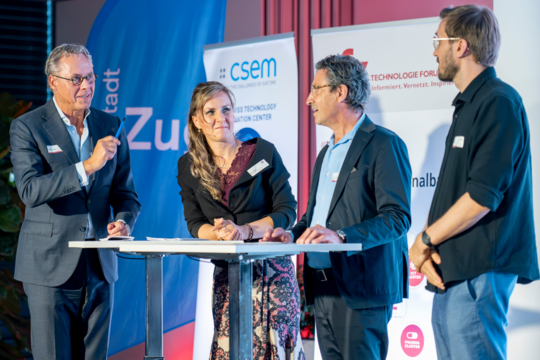
Mayor vs. Business
The transition to the networking segment took place on the big screen: In an entertaining video duel, Mayor André Wicki and Caroline-Isabelle Steiger, founder of the startup Fashion Genius, challenged each other. The central question was who could predict the future more accurately. Wicki wrapped up the segment with a key message. No one knows the future in detail. But rather than trying to predict it perfectly, the point is to actively shape it. It is precisely these visionaries who were sitting in the room that evening.
Innovations You Can Touch
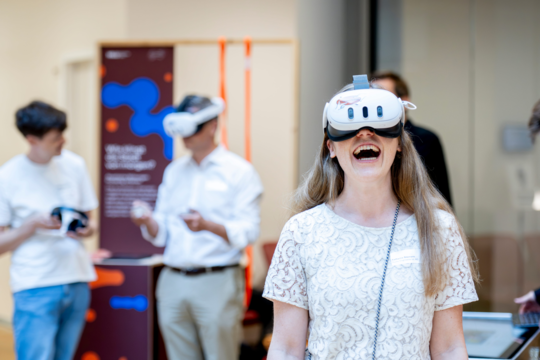
During the networking reception that followed, the foyer transformed into a lively marketplace. At the ID:Zug (Innovation Desk: Zug) booths, participants were able to examine the Sprinter prototypes up close and engage in in-depth discussions. A particular highlight was the Impact Space. There, HSLU brought the city of the future to life, while ETH Zurich facilitated philosophical discussions with an interactive Digital Einstein. In addition, Siemens opened its Experience Room, allowing guests to immerse themselves in modern building technology with all their senses.
An event of this magnitude is only possible thanks to strong support. The Zug Technology Forum would like to extend its heartfelt thanks to tfz enabler Zuger Kantonalbank, tfz technologypartner CSEM, tfz Developer Jörg Lienert AG, the event’s main sponsor Stadt Zug, sponsors ITZ, Digital & AI Community and Kanton Zug as well as Host Siemens and resource sponsors Hegglin Group AG and ConSol. DThe Zug Innovation Day 2026 has impressively demonstrated that Zug isn’t just talking about the future—it’s actively building it.